
Silverback Gorilla vs Human — Strength, Size, and the Real Comparison 2026
Silverback gorilla vs human Strength: A silverback gorilla is approximately 4 to 9 times stronger than an average adult human pound-for-pound, with an estimated bite force around 1,300 PSI (vs roughly 162 PSI for humans) and the ability to lift over 1,800 lbs (815 kg) more than four times the world record human deadlift.
A silverback weighs 140–230 kg (300–500 lbs) versus an average human male at 70–90 kg, and stands 1.4–1.8m tall but with an arm span far exceeding human proportions.
Despite this overwhelming physical power, wild mountain gorillas are gentle, non-aggressive herbivores that almost never attack humans during properly conducted gorilla trekking making Uganda’s Bwindi Impenetrable Forest one of the safest wildlife encounters on Earth despite the silverback’s extraordinary strength.
Few comparisons in the natural world capture the imagination quite like silverback gorilla vs human strength. Anyone who has watched footage of a silverback effortlessly snapping a bamboo stalk the thickness of a human wrist, or has stood face-to-face with one during gorilla trekking in Bwindi Impenetrable Forest, understands instinctively that they are in the presence of an animal whose raw physical power dwarfs anything the human body can produce.
Yet the same silverback that could overpower several grown men without effort spends 99% of its day calmly eating vegetation, grooming its family, and resting , one of nature’s most striking contrasts between potential power and actual behaviour.
This article gives you the complete, scientifically grounded comparison of silverback gorilla strength vs human strength covering bite force, lifting capacity, muscle density, size and weight, speed, and the real-world question every visitor planning a Uganda gorilla safari wants answered: is gorilla trekking safe given how strong a silverback actually is? We also cover what actually happens during a silverback charge, why attacks on humans are exceptionally rare, and how All Uganda Safaris prepares every trekker for a safe, unforgettable encounter with the world’s most powerful primate.
Silverback Gorilla Size vs Human Size — The Physical Comparison
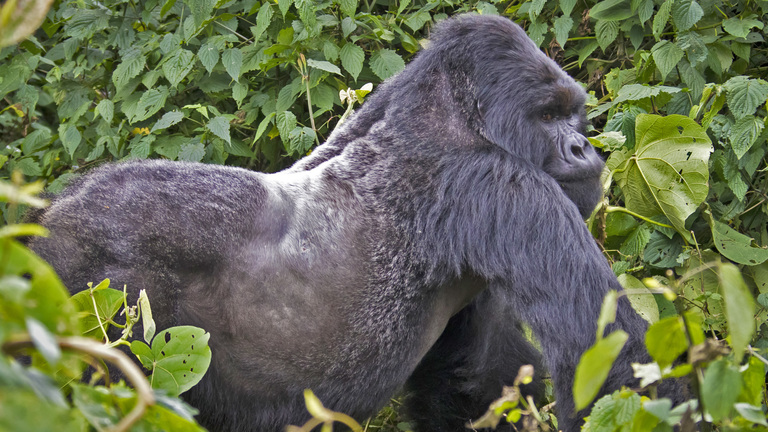
Before comparing strength, it helps to understand the raw size difference between a silverback gorilla and a human. A mature male mountain gorilla — known as a “silverback” because of the distinctive band of silver-grey hair that develops across his back and hips at full maturity, typically around 12–15 years of age — is dramatically larger and more densely built than even a large human male:
| Measurement | Silverback Gorilla | Average Adult Human Male | Difference |
| Standing height | 1.4–1.8 m (4.6–5.9 ft) | 1.7–1.8 m (5.6–5.9 ft) | Roughly similar standing height — but gorillas are far more massive |
| Body weight | 140–230 kg (300–500 lbs) | 70–90 kg (155–198 lbs) | Silverback is 2–3× heavier |
| Arm span | 2.0–2.7 m (6.5–9 ft) | ~1.7 m (matches height) | Gorilla arm span far exceeds height — humans roughly equal height/span |
| Chest circumference | 1.5–1.7 m (60–67 in) | 0.9–1.1 m (35–43 in) | Roughly 50–60% larger chest circumference |
| Hand size (palm width) | ~15–18 cm across | ~9–10 cm across | Nearly double the width |
| Skull/jaw muscle attachment | Sagittal crest present — huge jaw muscle anchor | No sagittal crest | Gorillas have a unique bony ridge for massive jaw muscles |
| Body fat percentage | Very low — almost entirely muscle and bone | Variable, typically 15–25% | Gorilla mass is overwhelmingly lean muscle |
The most important takeaway from this table is that a silverback’s mass is almost entirely dense, functional muscle rather than the mixed muscle-and-fat composition typical of even fit humans.
A silverback gorilla carries roughly twice the muscle mass per kilogram of body weight compared to a human — a structural advantage that, combined with sheer size, explains much of the strength gap explored below.
Silverback Gorilla Strength vs Human Strength — How Much Stronger Is a Gorilla?
The headline figure most people search for is simple: how many times stronger is a silverback gorilla than a human? Scientific estimates place a silverback gorilla at approximately 4 to 9 times stronger than an adult human, pound for pound, depending on the specific muscle group and movement tested.
This wide range exists because different studies measure different things — pulling strength, lifting strength, grip strength, and bite force all produce different multipliers.
Pulling and Lifting Strength — The Famous Comparisons
The most commonly cited statistic for gorilla lifting strength vs human lifting strength comes from research and zoo observation data: a silverback gorilla has been recorded as capable of lifting in excess of 1,800 lbs (815 kg) — more than four times the current human world record deadlift of approximately 501 kg (1,104 lbs), set by elite strongman athletes who have spent years specifically training that single movement.
An untrained adult human, by comparison, can typically deadlift 60–120 kg (130–265 lbs) — meaning the gap between an average human and a silverback gorilla in raw lifting strength is closer to 7 to 13 times
Why Are Gorillas So Much Stronger Pound-for-Pound Than Humans?
The scientific explanation for why gorillas are stronger than humans relative to body size comes down to several anatomical and physiological factors:
- Muscle fiber composition: Gorilla muscle contains a significantly higher proportion of fast-twitch muscle fibers — the fiber type responsible for explosive power — compared to the more mixed fiber composition in humans, who evolved greater endurance capacity at some cost to peak power output
- Muscle attachment points: Gorilla bones have larger, more leveraged muscle attachment points (origins and insertions), giving their muscles greater mechanical advantage for any given amount of muscle tissue
- No trade-off for bipedal balance: Humans evolved a body plan optimised for upright bipedal walking, running, and fine motor control — adaptations that came at the cost of raw power. Gorillas, as knuckle-walking quadrupeds, retained a body plan more directly optimised for strength
- Lower relative brain energy cost: Humans dedicate an estimated 20% of resting metabolic energy to the brain — gorillas dedicate proportionally less, freeing more metabolic capacity for muscle development and maintenance
- Evolutionary pressure for strength: Silverback gorillas compete directly for dominance, mating rights, and family group leadership through physical displays and occasional direct confrontation with rival males — creating sustained evolutionary pressure favouring extreme physical strength
Bite Force — Gorilla vs Human Jaw Power
A silverback gorilla’s bite force is estimated at approximately 1,300 pounds per square inch (PSI) — compared to an average human bite force of roughly 120–160 PSI
This means a silverback can bite with approximately 8 to 10 times the force of a human — strong enough to crush bamboo stalks, tough vegetation, and bone with apparent ease.
This extraordinary bite force is supported by the sagittal crest — the bony ridge running along the top of a mature silverback’s skull — which provides additional surface area for the attachment of powerful temporalis jaw muscles.
For comparison, a lion’s bite force is estimated at roughly 650 PSI and a chimpanzee’s at approximately 575 PSI — meaning a silverback gorilla’s bite is significantly stronger than a lion’s despite the gorilla being an herbivore.
Grip Strength — Hands Built for Different Purposes
A silverback gorilla’s grip strength is estimated to be considerably stronger than a human’s — though precise comparative figures are harder to establish than for bite force or lifting strength, since gorilla hands are not used identically to human hands in testing scenarios.
What is well documented is that gorillas use their immense hand and forearm strength routinely in the wild to strip tough vegetation, break thick bamboo stalks, and dig roots — physical tasks that would be impossible for an unaided human and that gorillas perform as a matter of daily feeding routine, completely unremarkable from the gorilla’s perspective.
| Strength Metric | Silverback Gorilla | Average Adult Human | Strength Ratio |
| Maximum lift capacity | ~1,800 lbs (815 kg) | ~130–265 lbs (60–120 kg) | ~7–13× stronger |
| Bite force (PSI) | ~1,300 PSI | ~120–160 PSI | ~8–10× stronger |
| Pulling strength | Estimated 4–9× human strength | Baseline | 4–9× stronger |
| Body weight ratio (lift vs body weight) | Can lift ~5–10× own body weight | Trained athletes ~1.5–2.5× body weight | ~3–5× more weight relative to size |
For perspective: A trained human strongman can deadlift around 500kg after years of dedicated training. A silverback gorilla can exceed that figure without any training at all — it is simply a baseline capability built into the animal’s muscle and skeletal structure. This is why wildlife experts describe gorillas as operating on a completely different physical scale to humans.
Silverback Gorilla Speed vs Human Speed
Despite their immense size, silverback gorillas are surprisingly fast over short distances — a fact that surprises many visitors on a Uganda gorilla trek. A silverback can charge at speeds of approximately 25–30 km/h (15–20 mph) over short bursts — faster than the world’s fastest human sprinters can sustain (Usain Bolt’s peak speed was approximately 44.7 km/h / 27.8 mph, but only elite sprinters approach that figure, and only briefly).
An average untrained human runs at roughly 8–12 km/h (5–8 mph), meaning a charging silverback would significantly outrun almost any human attempting to flee — one of the key reasons gorilla trekking guides instruct visitors never to run from a charging gorilla.
Running not only fails as an escape strategy against an animal this fast, it can also trigger a chase instinct that increases risk rather than reducing it.
Why Silverback Gorillas Rarely Use Their Strength Against Humans
Given the overwhelming physical power advantage a silverback gorilla holds over a human, the most remarkable fact about gorilla behaviour is how rarely that power is directed at people.
Understanding why requires understanding what silverback gorillas actually are: gentle, highly social, predominantly herbivorous primates whose strength evolved primarily for competing with other male gorillas, defending their family group, and processing tough plant material — not for attacking unfamiliar species.
What a Silverback Charge Actually Looks Like
A silverback charge — which many trekkers witness during gorilla trekking in Bwindi — is overwhelmingly a display behaviour, not a genuine attack. The full silverback display sequence typically includes: hooting vocalisations that increase in pitch and frequency, standing bipedally to appear larger, throwing vegetation, chest-beating with cupped hands (creating the iconic hollow drumming sound audible for over a kilometre), running sideways through vegetation, and then a short charge that stops well short of actual contact — known as a “bluff charge.”
This entire sequence is designed to communicate dominance and assess the threat level of whatever has approached the family group — it is a display of strength precisely because the silverback rarely needs to use that strength directly.
Correct Behaviour During a Silverback Charge
Every reputable Uganda gorilla trekking guide — including all guides used on All Uganda Safaris’ gorilla trekking tours — provides a mandatory safety briefing before every trek that covers exactly how to respond:
- Crouch down slowly: Lowering your body height and posture signals submission rather than challenge, defusing the perceived threat
- Avoid direct eye contact: Sustained direct eye contact is interpreted by gorillas (as with many primates) as a challenge or threat display
- Never run: Running triggers a chase instinct in an animal that can reach 25–30 km/h — a speed no human can outrun, and a movement that can escalate a bluff charge into a real pursuit
- Stay quiet and still: Loud noise and sudden movement both increase perceived threat. Calm stillness communicates non-aggression
- Follow your ranger’s instructions immediately: UWA rangers are trained specifically in gorilla behaviour and position themselves to mediate between trekkers and the gorilla family at all times
How Often Do Gorillas Actually Attack Humans?
Genuine gorilla attacks on humans during organised gorilla trekking are extremely rare — particularly relative to the scale of the strength differential involved. Decades of regulated gorilla trekking across Uganda, Rwanda, and the DRC, involving hundreds of thousands of visitor encounters, have produced only a handful of serious incidents — almost all involving either: a startled gorilla reacting defensively to a sudden unexpected movement or noise, a visitor violating the minimum distance guidelines, or extremely rare cases of a silverback mistaking rapid trekker movement for a threat during an active inter-group conflict.
Properly conducted gorilla trekking, following ranger instructions, carries minimal risk despite the silverback’s extraordinary physical capability — which is precisely why gorilla trekking has become one of Africa’s most celebrated wildlife tourism activities rather than a niche extreme-adventure pursuit.
How Does a Silverback Get So Strong on a Plant-Based Diet?
One of the most counter-intuitive facts about silverback gorilla strength is its dietary source: silverback gorillas are almost entirely herbivorous, consuming approximately 86% leaves, stems, and shoots; 7% fruit; 3% flowers; and the remainder bark, roots, and occasionally insects such as termites and ants.
A silverback can eat up to 18–20 kg (40–45 lbs) of vegetation per day — an enormous volume of relatively low-calorie-density plant material that the gorilla’s digestive system, including an enlarged fermenting gut, processes to extract sufficient protein and energy to build and maintain its extraordinary muscle mass.
This dietary fact has a counterintuitive but scientifically important implication: a silverback gorilla’s muscle mass and strength are built almost entirely from plant protein — directly contradicting the assumption that extreme muscle development requires high meat or animal protein intake.
The combination of constant low-intensity activity (foraging, climbing, walking), a high-fiber high-volume diet, and a genetically optimised muscular and skeletal structure together produce one of the strongest animals, relative to body mass, on Earth.
Where to See Silverback Gorillas in Uganda — Bwindi Impenetrable Forest
For visitors who want to witness a silverback gorilla’s power firsthand — safely, responsibly, and at close range — Bwindi Impenetrable Forest National Park in south-western Uganda offers the most accessible and best-organised mountain gorilla trekking experience in the world.
Bwindi protects over 400 mountain gorillas across approximately 50 family groups, with 19+ habituated families available for organised tourism trekking across four sectors: Buhoma, Ruhija, Rushaga, and Nkuringo.
Each family is led by at least one mature silverback — and most trekkers see the family’s dominant silverback up close during their one-hour permitted visit.
Gorilla Trekking Permit and What to Expect
A Uganda gorilla trekking permit costs USD $700 per person — significantly less than Rwanda’s $1,500 equivalent — and grants you one hour in close proximity to a habituated gorilla family, accompanied throughout by armed Uganda Wildlife Authority rangers and experienced trackers.
All Uganda Safaris organises gorilla trekking permits and complete safari logistics through tours including the 3-day gorilla trekking Bwindi tour, 2-day gorilla trekking Uganda, and the dedicated 1-day gorilla trekking Uganda for travellers with very limited time.
Gorilla Habituation Experience — More Time with the Silverback
For visitors who want extended observation time with a silverback and his family, the Gorilla Habituation Experience (GHE) offers up to four hours with a family that is still in the process of becoming accustomed to human presence, accompanying UWA researchers as they work directly with the gorillas.
This experience offers far more extensive observation of silverback behaviour — including feeding, vocalising, and the dominance displays described earlier in this article. See All Uganda Safaris’ 3-day gorilla habituation experience safari for details.
For a wider Uganda wildlife experience that pairs gorilla trekking with other primate species and East Africa’s classic safari wildlife, see our 4-day Kidepo wildlife tour, 3-day Kibale Forest chimpanzee trekking, and 4-day Queen Elizabeth National Park safari.
Silverback Gorilla vs Human — Quick FAQs
Can a silverback gorilla kill a human?
Physically, yes — a silverback gorilla possesses more than sufficient strength to cause fatal injury to a human given its lifting capacity, bite force, and size advantage. However, genuine fatal attacks on humans are exceptionally rare, particularly in regulated gorilla trekking contexts where rangers manage every encounter and gorillas have become accustomed to calm, non-threatening human presence over years of habituation.
How much can a silverback gorilla lift?
Silverback gorillas have been documented lifting in excess of 1,800 lbs (815 kg) — more than four times the human deadlift world record, achieved without any specific strength training.
Is a gorilla stronger than a lion?
In terms of raw bite force, a silverback gorilla’s bite (~1,300 PSI) significantly exceeds a lion’s bite force (~650 PSI). However, lions possess greater speed, predatory weaponry (claws, killing technique), and are obligate carnivores adapted for hunting — making a direct comparison complex and context-dependent rather than a simple “stronger” answer.
Why don’t gorillas use their strength to attack humans more often?
Gorillas are predominantly herbivorous, socially organised primates whose strength evolved primarily for competition between males, family group defence, and processing tough vegetation — not for predation or unprovoked aggression toward other species, including humans.
Is it safe to trek with silverback gorillas in Uganda?
Yes — properly conducted gorilla trekking with a licensed operator like All Uganda Safaris, following Uganda Wildlife Authority ranger guidance at all times, is widely regarded as one of Africa’s safest premium wildlife encounters, despite the silverback’s extraordinary physical capability.
Experience Silverback Gorillas Safely — Book Your Uganda Gorilla Safari
Witnessing a silverback gorilla’s extraordinary strength and gentle temperament up close — in Bwindi Impenetrable Forest’s ancient rainforest — is one of the most profound wildlife experiences available anywhere on Earth.
All Uganda Safaris organises fully licensed, professionally guided gorilla trekking safaris with complete permit booking, experienced trackers, and safety briefings for every trek.
Browse our gorilla trekking tours: 3-day gorilla trekking Bwindi tour · 2-day gorilla trekking Uganda · 1-day gorilla trekking Uganda · 3-day gorilla habituation experience safari · Browse all short Uganda safaris
Related Pages — All Uganda Safaris
- All Uganda Safaris — Home Page
- Short Uganda Safaris — Browse All Tours
- 1-Day Gorilla Trekking Uganda
- 2-Days Gorilla Trekking Uganda
- 3-Days Gorilla Trekking Bwindi Tour
- 3-Days Gorilla Habituation Experience Safari
- 3-Days Kibale Forest Chimpanzee Trekking
- 1-Day Ngamba Island Chimpanzee Tour
- 4-Days Queen Elizabeth National Park Safari
- 3-Days Queen Elizabeth Wildlife Safari
- 4-Days Kidepo Wildlife Tour
- 4-Days Murchison Falls Wildlife Safari
- 3-Days Murchison Falls Safari
- 2-Days Rhino Tracking Tour
- 1-Day Rhino Trekking Tour
- 3-Days Birding Safari Uganda
- 2-Days Lake Mburo Tour
- 1-Day Kampala City Tour
- 1-Day Jinja Tour