
Uganda – The Pearl of Africa | Travel, Safaris & Culture Guide 2025
Uganda: Discover Uganda, the Pearl of Africa — home to mountain gorillas, stunning lakes, and rich culture. Explore safaris, top attractions, and travel tips in this complete Uganda guide.
Introduction: Welcome to the Pearl of Africa
Nestled in the heart of East Africa, Uganda earns its nickname “The Pearl of Africa” from the legendary explorer Winston Churchill, who marveled at its unparalleled beauty during his 1907 visit.
Straddling the equator, this landlocked gem spans 241,038 square kilometers and boasts a vibrant tapestry of lush rainforests, snow-capped mountains, expansive savannas, and the world’s longest river, the Nile.
With a population of approximately 51.8 million as of late 2025, Uganda pulses with the energy of over 50 ethnic groups, each contributing to a mosaic of traditions, languages, and hospitality that welcomes visitors with open arms.
What sets Uganda apart? It’s the only country where you can trek endangered mountain gorillas one day and spot tree-climbing lions the next. Lake Victoria, Africa’s largest lake, cradles tropical islands, while the Rwenzori Mountains—Africa’s tallest range—pierce the clouds with glacial peaks just 100 kilometers from the equator.
Uganda’s warmth isn’t just climatic; its people, known for their infectious smiles and communal spirit, make every traveler feel at home.
In 2025, as the country gears up for economic leaps driven by oil production and tourism, Uganda offers more than adventure—it’s a profound connection to nature’s raw power and humanity’s enduring spirit.
Whether you’re a wildlife enthusiast, cultural explorer, or investor eyeing untapped potential, this guide unlocks the Pearl’s secrets. At All Uganda Safaris, we’re your gateway to these wonders—book with us for seamless, expert-led journeys that blend thrill with sustainability.
Where Is Uganda Located?
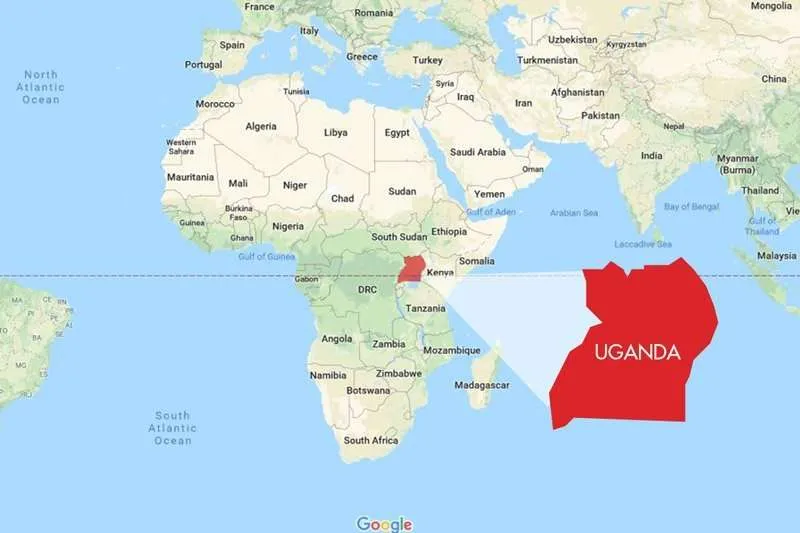
Tucked away in East Africa, Uganda lies entirely within the equatorial belt, making it a year-round haven for sun-seekers and adventurers alike. Spanning latitudes 4° north to 1° south, its coordinates center around 1° N, 32° E, covering a diverse topography from volcanic highlands to rift valley lakes.
Uganda shares borders with five nations: Kenya to the east, South Sudan to the north, the Democratic Republic of Congo (DRC) to the west, Rwanda and Tanzania to the south, and a sliver of Lake Victoria touching South Sudan indirectly.
This strategic position makes it the gateway to the Great Lakes region, fostering trade routes and cultural exchanges that date back centuries.
Geographically, Uganda is a basin of contrasts: the Albertine Rift in the west harbors half the world’s mountain gorillas, while the arid northeast Karamoja region echoes with nomadic herder traditions.
The equator slices through the south, creating microclimates where coffee thrives on volcanic soils and bananas—matoke—feed millions. For visual context, imagine a map where Lake Victoria dominates the southeast, the Nile’s source bubbles at Jinja, and Bwindi’s impenetrable forests cloak the southwest border with DRC.
Map showing Uganda location in East Africa
Searching “where is Uganda located in Africa” often leads here, as does “Uganda map” or “Uganda location facts.” Fun fact: At 1,127 meters above sea level, Kampala’s elevation tempers the tropical heat, averaging a balmy 23-29°C year-round.
This prime spot not only boosts biodiversity—over 1,000 bird species and 345 mammal types—but positions Uganda as a hub for regional safaris.
From Entebbe International Airport, you’re just a short flight from Nairobi or Kigali, amplifying its appeal for multi-country itineraries. All Uganda Safaris specializes in seamless transfers, ensuring your equatorial odyssey begins stress-free.
Uganda Tourism and Safaris: Wildlife Wonders Await
Uganda’s tourism scene is a blockbuster, with safaris drawing over 1.5 million visitors annually in 2025, fueling a sector that contributes 8% to GDP. Dubbed the “cradle of primates,” it’s the ultimate for “Uganda safari tours” and “gorilla trekking in Uganda.” At All Uganda Safaris, we craft bespoke experiences that spotlight the best national parks, blending adrenaline with eco-responsibility.
Start with Bwindi Impenetrable National Park, a UNESCO site where 50% of the world’s 1,063 mountain gorillas roam misty highlands. Gorilla trekking here—book your $800 permit through us—delivers heart-stopping encounters: a silverback’s gaze, playful juveniles tumbling in bamboo groves.
Permits cost $800 for foreign non-residents in 2025, with habituation experiences at $1,500 for four hours of immersion. Nearby, Mgahinga Gorilla National Park offers rarer golden monkey tracking amid volcanic craters.
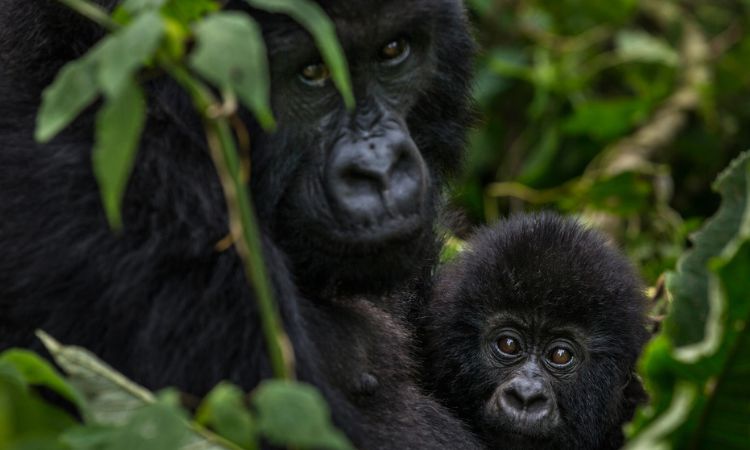
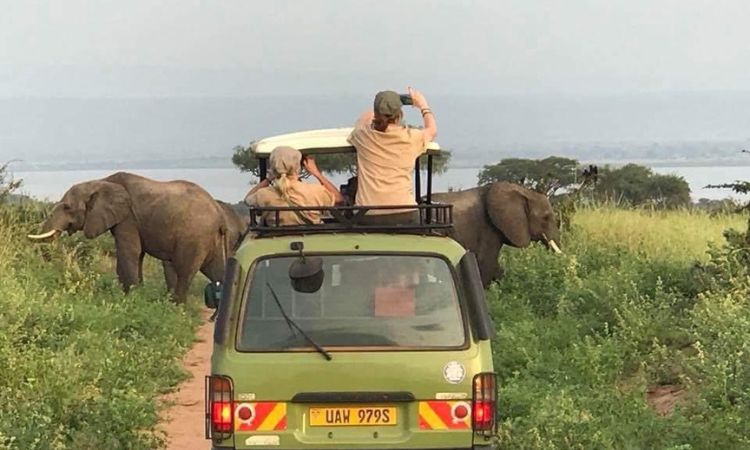
Venture to Queen Elizabeth National Park, famed for tree-climbing lions in Ishasha sector and hippo-packed Kazinga Channel boat cruises. Spot the Big Five—lion, elephant, leopard, buffalo, rhino—on game drives, or birdwatch 600+ species, including the shoebill stork. Murchison Falls National Park, Uganda’s largest, thunders with the Nile’s might: launch a boat safari to the base where 43 meters of water explode through a 7-meter gorge, then drive to spot Rothschild giraffes and Nile crocodiles.
Don’t miss Kibale Forest National Park, the “Primate Capital,” for chimpanzee habituation treks amid 1,500 chimps. “Best national parks in Uganda” searches peak here for good reason—over 70 primate species. All Uganda Safaris handles permits, guides, and logistics, ensuring ethical wildlife viewing.
In 2025, with oil revenues boosting conservation, these parks are greener than ever. Pro tip: Combine with cultural add-ons for a holistic safari—your adventure, our expertise.
Top Attractions in Uganda: Must-Visit Gems
Uganda’s allure lies in its eclectic attractions, from primal forests to adrenaline hubs. Here’s a curated list, rich with “best places to visit in Uganda” vibes, complete with vivid snapshots.
- Bwindi Impenetrable National Park – Dive into mist-shrouded trails for gorilla magic.
- Murchison Falls National Park – Witness the Nile’s fury; rhinos reintroduced in 2025 boost Big Five sightings.
- Queen Elizabeth National Park – Safari bliss with canal hippos and crater lakes.
- Kibale Forest – Chimp tracking and boardwalk birding in a 795 km² green lung.
- Lake Bunyonyi – Africa’s second-deepest lake (900m), dotted with 29 terraced islands; kayak amid mist.
- Jinja – Nile’s source, East Africa’s adventure capital: Bungee (44m drop), white-water rafting Class V rapids.
- Rwenzori Mountains National Park – “Mountains of the Moon”: Hike to Margherita Peak (5,109m), Uganda’s highest, with equatorial snow.
- Ssese Islands – 84 tropical paradises on Victoria; beach-hop, fish, unwind.
These spots, from “things to do in Uganda” lists, blend nature and culture. All Uganda Safaris curates multi-day itineraries—trek gorillas, then chill by Bunyonyi—for unforgettable escapes.
Culture and People of Uganda: A Vibrant Mosaic
“Culture of Uganda” queries reveal a nation of 56 tribes, from Baganda (central, 16% population) to Banyankole (western cattle herders) and Acholi (northern dancers). English and Swahili are official, but Luganda, Runyankole, and Ateso echo in markets.
“Tribes of Uganda” thrive in harmony, evident in “Ugandan traditions” like the Baganda’s royal kmaba (drum ceremonies) or Karamojong’s Turkana-like beadwork.
Immerse via Batwa pygmy visits—ancient forest dwellers sharing honey-hunts—or Ndere Cultural Centre’s whirlwind dances: Kiganda’s graceful sweeps, Acholi’s rhythmic bows.
Village homestays unveil communal feasting, storytelling under acacia stars. In 2025, festivals like Nyege Nyege amplify global fusion. Ugandans’ warmth? It’s legendary—expect invitations to Rolex stands. All Uganda Safaris weaves cultural threads into safaris, fostering authentic bonds.
Ugandan Food: Flavors of the Pearl
“What is Uganda’s most famous food?” Rolex—a chapati rolled with egg, onions, and peppers—reigns as street king, dubbed CNN’s “best street food” in 2013.
“Ugandan food” staples: Matoke (steamed plantains in peanut sauce), luwombo (stewed meat/fish in banana leaves), posho (maize porridge), and groundnut sauce over millet bread.
“Traditional Ugandan dishes” like katogo (bean-matoke mix) fuel trekkers; “what to eat in Uganda” includes tilapia from Victoria, Rolex at UGX 2,000 (~$0.55).
Street stalls buzz in Kampala’s Owino Market; upscale spots like Kabuufu blend fusion. Pair with waragi (banana gin) or tonic-club soda. All Uganda Safaris includes farm-to-table meals—savor luwombo post-trek.
Economy and Investment Opportunities in Uganda
“Uganda economy 2025” forecasts 6.2-7.5% GDP growth, hitting $53.65 billion, ranking 15th in Africa by nominal GDP. Agriculture (24% GDP) leads with coffee ($800M exports), but oil (6B barrels) starts 2025 production, eyeing 10% growth by 2027.
Mining booms: Gold, copper, cobalt for green tech. “Investment opportunities in Uganda”: Real estate in Wakiso, renewables (hydropower), tourism lodges. What makes Uganda rich? Fertile soils (70% arable), rainfall, minerals (gold, cobalt), oil, biodiversity—untapped for $2.4B annual potential.
Challenges? Youth unemployment (13%), but 10M-strong workforce beckons. All Uganda Safaris partners for eco-investments.
Travel Tips for Visitors
“Travel to Uganda” essentials: e-Visa ($50, apply online) or East African Tourist Visa ($100 for Uganda, Kenya, Rwanda).
Currency: UGX (~3,700/$1). Health: Yellow fever vaccine mandatory; malaria prophylaxis. Fly into Entebbe; roads improved, but 4x4s rule. Best time: Dry June-September, December-February.
|
Month |
Avg Temp (°C) |
Rainfall (mm) |
Best For |
|
Jan |
23-29 |
68 |
Safaris |
|
Apr |
20-27 |
200 |
Birding |
|
Jul |
20-27 |
50 |
Trekking |
|
Oct |
22-28 |
120 |
Culture |
“Is it safe to travel to Uganda right now?” Yes, for tourists—stable, with low crime in parks; avoid north near DRC, stay vigilant in Kampala.
“Uganda’s biggest problem?” Corruption and inequality, costing $2.4B yearly, amid youth bulge. All Uganda Safaris ensures secure, guided trips.
Accommodation in Uganda
“Where to stay in Uganda”? Kampala’s Speke Resort (luxury) or budget Red Chilli; Entebbe’s Lake Victoria Serena. Parks: Bwindi’s Sanctuary Gorilla Forest Camp ($500/night) or mid-range Buhoma Lodge.
“Best lodges in Uganda”—our picks: Ishasha Wilderness for lions. All Uganda Safaris books eco-luxury seamlessly.
Wildlife and Nature
“Wildlife in Uganda”: Big Five, 1,000+ birds (Mabamba Swamp for shoebills), primates galore. “Uganda birdwatching” hotspots: Semuliki’s 400 species. Biodiversity hotspot—protect with us.
Uganda Facts
- Capital: Kampala
- Population: ~51.8 million
- Languages: English, Swahili
- Currency: UGX
- Calling code: +256
- National animal: Grey crowned crane
- Independence: October 9, 1962
- How many states (districts) in Uganda? 146 as of 2025
- Where is Uganda ranked in Africa? 15th by GDP, 7.5% growth leap
- What is the no. 1 poorest country? South Sudan (not Uganda)
FAQ
Where is Uganda located? East Africa, equator-straddling borders with Kenya, Tanzania, Rwanda, South Sudan, DRC.
Is Uganda safe for tourists? Yes, especially guided; vigilance advised.
When is the best time to visit Uganda? June-September, December-February.
How much is a gorilla permit in Uganda? $800 (foreign non-residents).
Do I need a visa to travel to Uganda? Yes, e-Visa online.
What is Uganda’s most famous food? Rolex.
Ready to Explore?
Ready to explore the Pearl of Africa? Book your Uganda safari or cultural tour today with All Uganda Safaris.