
Top 10 Intriguing Facts about an African Buffalo
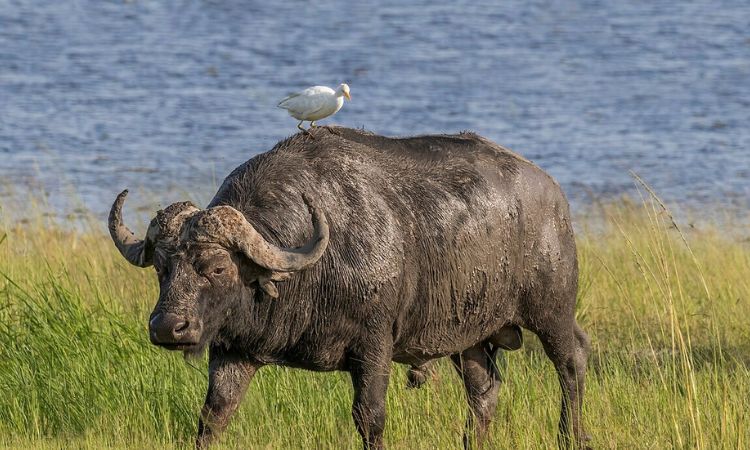
The African buffalo scientifically called Syncerus caffer, and also widely known as the Cape buffalo, is one of Africa’s most iconic and formidable wild animals.
Found across sub-Saharan Africa, including in Uganda’s premier national parks, this powerful bovine is a member of the famed Big Five—a group that also includes lions, elephants, leopards, and rhinoceroses.
The African buffalo earns its reputation not just from its impressive size but from its unpredictable temperament, earning nicknames like “Black Death” or “widowmaker” among hunters due to its tendency to charge when threatened.
Unlike the American bison or Asian water buffalo, the African buffalo is a true wild species that has never been domesticated. In Uganda, where wildlife safaris thrive, spotting massive herds of these animals grazing in savannas or wallowing near water sources is a highlight for visitors.
African Buffalo Quick Facts
To help you quickly grasp the essentials (perfect for featured snippets), here’s a summary of key facts:
- Scientific name: Syncerus caffer
- African buffalo nickname: Cape buffalo, Black Death
- African buffalo size: Shoulder height 1.0–1.7 m (3.3–5.6 ft); body length 1.7–3.4 m (5.6–11.2 ft)
- African buffalo weight: Males 425–870 kg (up to 1,000 kg); females slightly less
- Lifespan: Up to 20 years in the wild; 26–29 years in captivity
- Habitat: Savannas, woodlands, floodplains; always near water
- Diet: Primarily grass (grazers)
- Predators: Lions (main), crocodiles, hyenas (mostly calves)
- Conservation status: Near Threatened (IUCN)
These robust animals are highly social and dependent on water, drinking daily and often wallowing in mud for protection against parasites and heat.
Types of Buffalo: Clarifying the Differences
The term “buffalo” can cause confusion, as it refers to several unrelated species. Here’s a breakdown to capture broader search interest:
- African buffalo (Cape buffalo): The focus here—the large, black savanna-dwelling subspecies (Syncerus caffer caffer), common in East and Southern Africa, including Uganda.
- Forest buffalo: A smaller, reddish subspecies (Syncerus caffer nanus) found in Central and West African rainforests. Are African forest buffalo aggressive? Yes, they share the species’ defensive nature but live in smaller groups (8–20) and are more elusive.
- African buffalo vs water buffalo: Water buffalo (Bubalus bubalis) are native to Asia, often domesticated for milk and labor. They have longer, crescent-shaped horns without a “boss,” prefer wetlands, and are generally less aggressive in the wild.
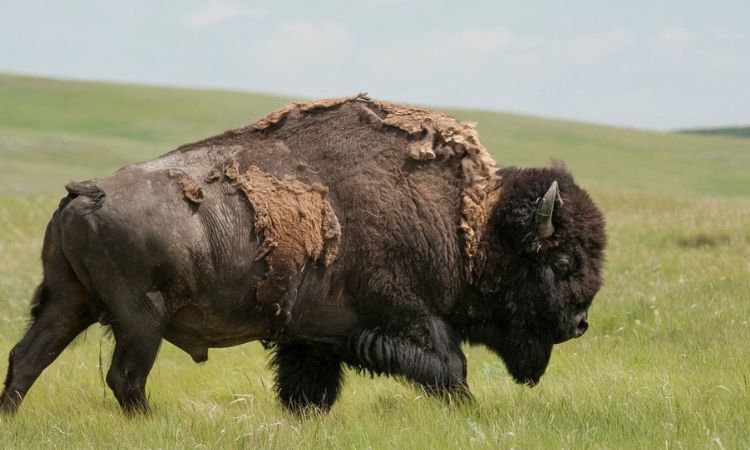
- African buffalo vs American bison: American bison (Bison bison) are North American, with a prominent shoulder hump, shaggier fur, shorter/sharper horns, and no fused boss. Bison live in open plains and were nearly extinct due to hunting; they lack the African buffalo’s reputation for danger.
What are the buffalo in Africa called? Primarily African buffalo or Cape buffalo. What kind of buffalo are in Uganda? Mostly savanna types similar to Cape buffalo, with some hybrids showing reddish tones influenced by forest genetics.
African Buffalo Habitat & Distribution
African buffalo thrive in diverse habitats across sub-Saharan Africa, from open savannas to woodlands and floodplains, as long as water is nearby. Key countries include Uganda, Kenya, Tanzania, Botswana, and South Africa.
In Uganda, they are abundant in savanna parks:
- Queen Elizabeth National Park: Iconic for large herds grazing near the Kazinga Channel.
- Murchison Falls National Park: Over 10,000 individuals; often seen along the Nile River.
- Kidepo Valley National Park: Smaller but visible populations in remote valleys.
These protected areas ensure buffalo thrive, contributing to Uganda’s world-class safari experiences.
African buffalo Physical Characteristics
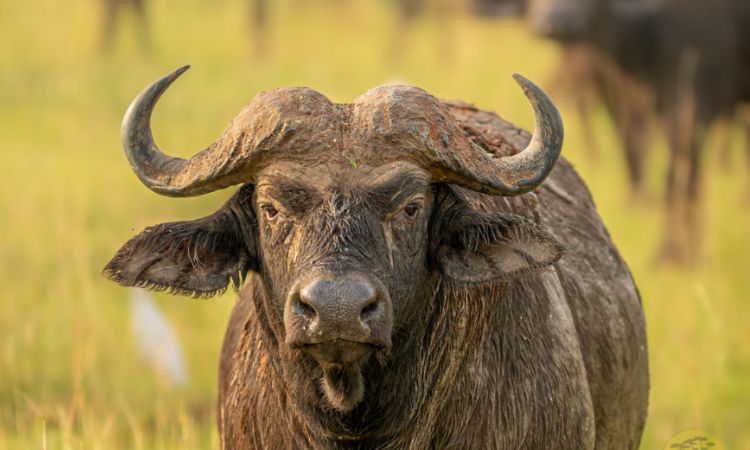
The African buffalo’s most distinctive feature is its massive, curved horns with a fused base forming a thick “boss” in mature males—a helmet-like shield used in dominance fights.
- Size variations: Savanna types (like Cape buffalo) are largest; forest buffalo half the weight.
- Coat: Dark black or brown in adults; calves reddish-brown.
- Male vs female: Males heavier with thicker bosses; females smaller horns.
Bold fact: An adult male can weigh up to 870 kg and charge at speeds over 50 km/h.
Behavior & Social Structure
Are African buffalo dangerous? Absolutely—considered one of Africa’s most dangerous animals due to their aggression when wounded or threatened. They gore or trample hundreds annually.
Buffalo are highly social:
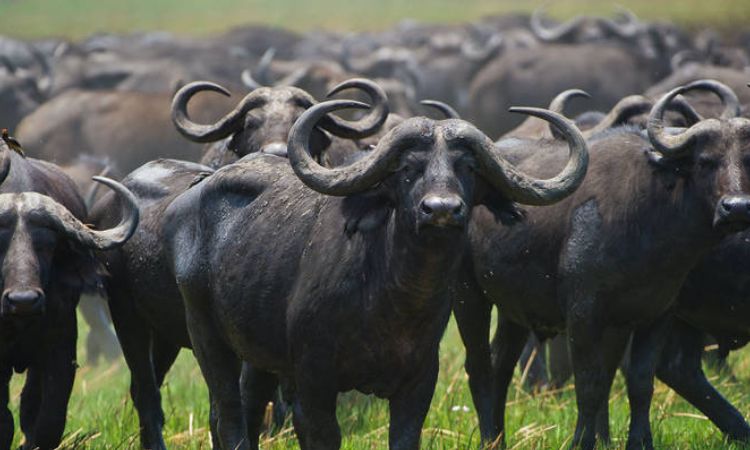
- Herd sizes: 50–500+ in savannas (up to 2,000); smaller in forests.
- Structure: Matriarchal core of related females/offspring; bachelor males; dominant bulls.
- Defensive behavior: Herds mob predators, forming a protective front with calves in the center.
- Famous for charging lions or rescuing herd members.
They communicate via grunts, bellows, and body language.
Diet & Feeding Habits
Strict grazers, buffalo consume coarse grasses other animals avoid. They feed mostly at dawn/dusk, spending 18 hours daily foraging. Water-dependent, they drink daily and shape ecosystems by clearing tall grasses for smaller grazers.
Buffalo Predators & Defense Mechanisms
Lions are the primary predator, often requiring a pride to tackle an adult. Crocodiles ambush at water. Buffalo counter with herd cooperation—charging en masse or circling to protect vulnerable members. Epic buffalo-lion battles are safari highlights.
Buffalo Reproduction & Life Cycle
Breeding peaks in rainy seasons. Gestation ~340 days; single calf born (rarely twins). Calves hide in vegetation initially, then join the herd. Weaned at 6–10 months; maturity 3–5 years. Maternal bonds strong; females stay in natal herds.
Conservation Status & Threats
The African buffalo is classified as Near Threatened by the IUCN, with a decreasing population of around 400,000 individuals. Major threats include habitat loss and fragmentation, poaching for bushmeat/trophies, diseases from livestock, and human-wildlife conflict.
In Uganda, protected parks support stable populations. Conservation via anti-poaching and tourism revenue is vital.
Buffalo in Uganda Safaris
Uganda offers prime buffalo viewing:
- Best parks: Queen Elizabeth (herds near water), Murchison Falls (Nile boat safaris).
- Best time: Dry season (June–September, January–February) for concentrated sightings.
- Herd sizes: Often 100–500.
- Safety tips: Stay in vehicles; never approach on foot—respect their space.
Safaris here combine buffalo with Big Five sightings, gorillas, and chimps for unforgettable adventures.
FAQs about an African Buffalo
Is a buffalo more dangerous than a lion? Many hunters say yes—buffalo kill more people annually due to charges.
What is the difference between a buffalo and a bison? See types section: hump, horns, habitat.
How fast can an African buffalo run? Up to 57 km/h (35 mph).
Are buffalo aggressive? Defensive yes; unprovoked attacks rare in herds.
Can buffalo be domesticated? No—unlike water buffalo.
The African buffalo embodies raw power and resilience, a cornerstone of Uganda’s wildlife heritage. From thundering herds in Queen Elizabeth to Nile-side gatherings in Murchison Falls, encountering these majestic animals on safari is thrilling. By understanding and conserving them, we preserve Africa’s wild heart.
For more Uganda adventures, Contact us to explore Big Five safaris, Queen Elizabeth National Park guides, or Murchison Falls experiences.