
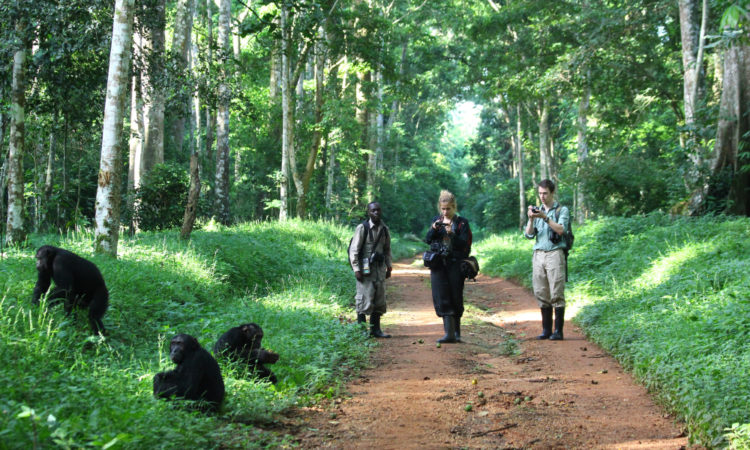
2026 Top Guide to Budongo Forest:Location, Chimp Trekking, & more
Budongo Forest Uganda: Complete guide to chimpanzee tracking, Royal Mile birdwatching, permits, best time to visit, and accommodation. Discover why Budongo Forest Reserve offers one of the most authentic, affordable, and uncrowded chimp trekking experiences in Africa – including Kaniyo Pabidi permits, costs, how to get there from Kampala or Murchison Falls, plus tips on the best lodges and tours.
Introduction
Budongo Forest, also known as Budongo Forest Uganda, stands as one of East Africa’s most captivating natural treasures. Nestled in the heart of Uganda, this semi-deciduous tropical rainforest is renowned for its Budongo Forest chimpanzee tracking adventures, drawing eco-tourists and wildlife enthusiasts from around the globe.
Spanning an impressive 825 square kilometers, Budongo Forest Reserve is the largest mahogany forest in East Africa and a biodiversity hotspot teeming with over 600 chimpanzees, vibrant birdlife, and ancient giant trees.
But where exactly is Budongo Forest found? It’s located on the escarpment northeast of Lake Albert, on the southern edge of Murchison Falls National Park, making it a seamless extension of any Uganda safari itinerary.
What makes Budongo Forest famous? Its rich Budongo Forest ecosystem supports habituated chimpanzee communities, offering intimate encounters that rival those in more crowded spots like Kibale.
Whether you’re searching for Budongo Forest location details or dreaming of a Budongo Forest chimp trekking expedition, this guide covers everything from conservation efforts to practical travel tips.
As Uganda’s premier destination for primate encounters, Budongo Forest combines adventure, education, and conservation in one unforgettable package. Ready to explore? Let’s dive into the canopy.
Budongo Forest Location and How to Get There
Understanding the Budongo Forest location is key to planning your trip. Budongo Forest is situated in the Masindi District of northwestern Uganda, approximately 237 kilometers north of Kampala, the capital city.
This places it strategically on the escarpment overlooking the Albertine Rift Valley, just 20 kilometers from the entrance to Murchison Falls National Park.
In which district is Budongo Forest? Precisely in Masindi District, bordering the expansive Murchison Falls, which enhances its appeal for combined wildlife safaris.
The distance from Kampala to Budongo Forest is about 4-5 hours by road, while it’s a mere 1-hour drive from Masindi town and 30 minutes from Paraa, the main gateway to Murchison Falls.
For those wondering where is Budongo Forest found, it’s at coordinates roughly 1°55’N 31°35’E, making it accessible yet remote enough to feel wild.
Getting to Budongo Forest is straightforward with several transport options. The primary route is via the Kampala-Masindi highway (A104), a well-paved road that winds through scenic countryside.
Self-drive in a 4×4 vehicle is ideal for the final 20-kilometer stretch into the forest, which can be bumpy during rains. Public transport includes shared minibuses (matatus) from Kampala to Masindi, followed by a boda-boda (motorcycle taxi) or taxi to the Kaniyo Pabidi ranger post.
For hassle-free travel, book with reputable tour operators like those specializing in Budongo Forest tours, who provide air-conditioned vans, experienced guides, and seamless transfers.
Budongo Forest map
Pro tip: If combining with Murchison Falls, fly into Pakuba Airstrip (1-hour flight from Entebbe) to shave off driving time. With its proximity to major attractions, Budongo Forest is a must-add to any Uganda itinerary.
History and Ecology of Budongo Forest
The story of Budongo Forest is one of resilience and renewal. Gazetted as a forest reserve in 1932, it became one of Uganda’s oldest protected areas, initially managed for timber extraction under British colonial rule.
Commercial logging targeted its iconic mahogany stands in the mid-20th century, but conservation efforts ramped up in the 1990s with the involvement of the Jane Goodall Institute.
Today, Budongo Forest conservation initiatives focus on habitat restoration and anti-poaching, safeguarding this vital Budongo Forest ecosystem.
Ecologically, Budongo Forest is a semi-deciduous tropical rainforest at altitudes of 750-1,000 meters, transitioning from lush evergreen to drier woodland.
Why is Budongo Forest called a natural forest? Unlike planted monocultures, it’s a primary, ancient woodland shaped by millennia of natural processes, boasting over 465 plant species.
Tree species in Budongo Forest include towering mahoganies (Entandrophragma cylindricum, E. utile, E. angolense, and Khaya anthotheca), which can reach 80 meters tall and 20 meters in circumference. Other notables are ironwood (Cynometra alexandri), figs, and musanga trees, creating a multilayered canopy that supports immense biodiversity.
Unique features abound: The forest harbors rich birdlife (over 360 species), primates, and even forest elephants. It’s not Uganda’s largest planted forest—that title goes to areas like those in Mabira Forest, a central Ugandan rainforest often compared for its own conservation battles against deforestation.
Mabira Forest, covering 306 km², is denser and more urban-adjacent, while Budongo’s 825 km² expanse feels wilder and more primate-focused. How big is Budongo Forest? At 825 km², it’s vast enough for immersive exploration yet compact for day trips.
This ecology isn’t just beautiful—it’s a carbon sink and wildlife corridor, underscoring the urgency of Budongo Forest conservation against threats like snares in Budongo Forest, which we’ll discuss later.
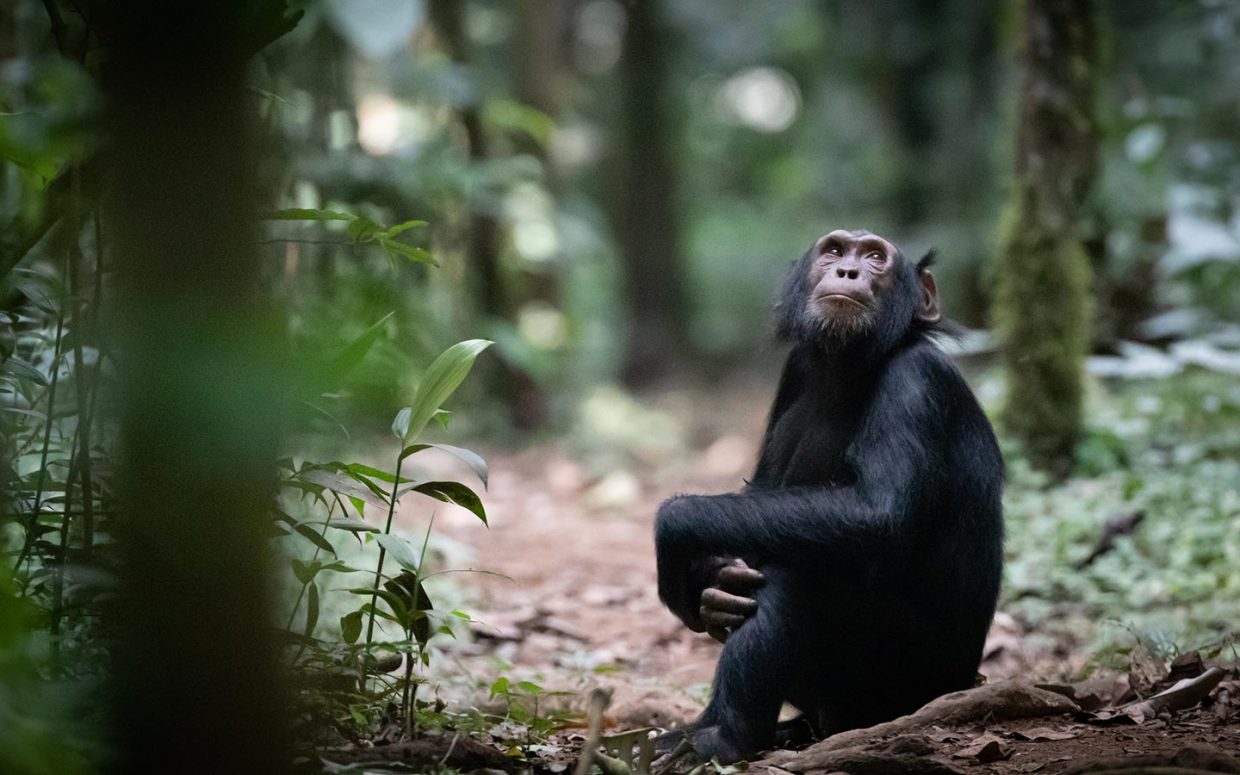
Chimpanzee Tracking in Budongo Forest (Main Attraction)
No visit to Budongo Forest is complete without Budongo Forest chimpanzee tracking, the reserve’s crown jewel. Home to over 600 chimpanzees divided into eight communities, Budongo offers unparalleled access to these intelligent primates.
The habituation experience at Kaniyo Pabidi Forest Station—on the forest’s eastern edge—allows you to spend up to four hours observing four habituated groups: Sonso, Chamber, B-group, and the research-focused Royal Mile community.
Budongo Forest chimp trekking begins with a briefing at 7:30 AM or 1:00 PM, followed by a 2-5 hour hike through undulating trails. Expect to spot chimps foraging, grooming, or even tool-using—cracking nuts with stones.
The best time for chimp trekking is during dry spells when groups stay lower in the canopy. Duration averages 3-4 hours, but full-day habituation (8 hours, $250 permit) immerses you deeper into their world.
Costs for Kaniyo Pabidi chimp permits are $85 for foreigners (non-residents), plus $40 UWA entry. Rules are strict: Maintain 7-meter distance, no flash photography, and groups limited to 6-8 trekkers for minimal disturbance.
Why is Budongo one of the best places to trek chimps in Uganda? With success rates over 90%, it’s less crowded than Kibale (fewer tourists, more intimate sightings) and cheaper. Chimpanzee trekking in Budongo Forest feels authentic, blending adventure with education on chimp behavior.
For a unique twist, join the Royal Mile chimp research—launched in 2008—where scientists track behaviors in this iconic trail’s community.
Other Wildlife in Budongo Forest
Beyond chimps, Budongo Forest pulses with life. Primates dominate: Spot red-tailed monkeys with their fiery backs, blue monkeys (entellus) leaping through branches, black-and-white colobus with flowing tails, and olive baboons patrolling troops.
Mammals include elusive forest elephants (smaller than savanna kin), forest buffaloes, bushbucks, duikers, and elusive leopards at dusk.
Reptiles slither through the understory—green tree vipers and monitor lizards—while over 130 butterfly species flutter in iridescent clouds. This diversity stems from the forest’s varied habitats, from swampy valleys to hilly ridges.
Birdwatching in Budongo Forest
Birders, rejoice: Birdwatching in Budongo Forest reveals over 360 species, including eight Albertine Rift endemics. The star is Puvel’s Illadopsis, a secretive Budongo speciality skulking in undergrowth.
Spot the iridescent Chocolate-backed Kingfisher along streams, the elusive Nahan’s Francolin in thickets, and the Yellow-footed Flycatcher flitting through clearings.
Prime spots include the Royal Mile—a 5-km canopy trail lined with giant mahoganies, perfect for dawn choruses—and Nyakafunjo Swamp for waterbirds. Budongo Forest bird species thrive year-round, but dry seasons yield clearer views. Guided walks ($20-30) enhance sightings of hornbills, turacos, and flycatchers.
Top Tourist Activities in Budongo Forest
Budongo Forest brims with activities beyond trekking. Chimp trekking is flagship, but nature walks along the Royal Mile—named for its regal tree avenue—offer serene hikes amid butterflies and birds.
Birdwatching tours target specials, while ecology and research tours at the Budongo Conservation Field Station let you assist in data collection, learning about snares in Budongo Forest (wire traps maiming chimps; eco-guards remove thousands yearly).
Cultural tours visit nearby Banyoro communities for drumming sessions and craft markets, fostering sustainable tourism. For adrenaline, combine with Murchison’s boat safaris.
Best Time to Visit Budongo Forest
Timing matters for best time to visit Budongo Forest. Dry seasons—June to August and December to February—feature sunny days, dry trails, and active wildlife near waterholes. Temperatures hover at 25-30°C, ideal for trekking.
Rainy seasons (March-May, September-November) bring lush greenery but muddy paths and swollen streams, potentially shortening treks. Best time to visit Budongo Forest aligns with chimp fruiting peaks in dry months for lively encounters. Avoid peak rains for comfort.

Accommodation Near Budongo Forest
Where to stay in Budongo Forest? Options range from luxury to budget. Budongo Eco Lodge, perched inside the reserve, offers treehouses with chimp-viewing decks ($150-250/night, full board).
For Murchison proximity, Pakuba Safari Lodge ($200+) boasts Nile views and pools; Paraa Safari Lodge ($180+) features riverside luxury; Chobe Safari Lodge ($150+) emphasizes eco-chic.
Budget stays in Masindi include New Mansoor Hotel ($50/night) or guesthouses. Book ahead for dry seasons.
Entry Fees & Permit Prices
Access is affordable: UWA entrance is $40/day for foreigners, valid for the reserve. Chimp trekking permit cost is $85 (tracking) or $250 (habituation). Birdwatching and nature walks add $20-30, forest walks $15. Fees support conservation, including anti-snare patrols.
Tour Packages Featuring Budongo Forest
Elevate your visit with Budongo Forest tours. A 3-Day Murchison Falls with Chimp Trekking ($800-1,200/person) includes transfers, permits, and game drives. The 5-Day Uganda Primates & Wildlife tour ($1,500+) adds Queen Elizabeth. Custom private tours tailor to birding or research. Uganda safari with Budongo Forest often bundles with gorilla trekking for epic journeys.
Travel Tips for Visiting Budongo Forest
Pack wisely: Hiking boots for muddy trails, rain jacket (even in dry season), long trousers against insects, binoculars, and malaria prophylaxis.
Fitness level: Moderate—treks involve hills; consult guides if mobility-limited. Safety: Stick to paths, no solo ventures; water is safe at lodges.
Best tour operators: Uganda Wildlife Authority partners like us at All Uganda Safaris ensure ethical experiences.
Conservation & Research Work
Budongo Forest conservation shines through Jane Goodall Institute partnerships. Ongoing chimpanzee studies at Sonso monitor health and behavior, revealing tool-use innovations.
Threats like snares in Budongo Forest—indiscriminate traps injuring 36% of chimps—prompt eco-guard patrols removing 3,000+ annually. Habitat loss from logging and agriculture looms, but community initiatives plant native trees and promote alternatives to bushmeat.
The Royal Mile hosts research on chimp social dynamics, contributing global data. These efforts build E-E-A-T, proving Budongo’s authority in primate science.
FAQs About Budongo Forest
Where is Budongo Forest located? In Masindi District, northwestern Uganda, near Murchison Falls NP.
How much is chimpanzee trekking in Budongo Forest? $85 for a tracking permit, plus $40 entry.
Is Budongo better than Kibale for chimp trekking? Budongo offers fewer crowds and cheaper permits ($85 vs. $200 in Kibale), with 90% success rates. Kibale has more chimps (1,500 vs. 600) and easier terrain, but Budongo feels more remote and research-oriented.
How many chimpanzees are in Budongo Forest? Over 600 across eight communities.
In which district is Budongo Forest? Masindi District.
What are tree species in Budongo Forest? Mahoganies, ironwood, figs, and 465+ others.
What is the Royal Mile in Budongo Forest? A 5-km birding trail with ancient trees.
Why is Budongo Forest called a natural forest? It’s a primary, unplanted rainforest evolved over millennia.
Conclusion
Budongo Forest encapsulates Uganda’s wild heart—from chimpanzee trekking in Budongo Forest to its majestic mahoganies and conservation triumphs. This 825 km² haven, far from being Uganda’s largest planted forest like parts of Mabira, remains a natural masterpiece.
Ready for your adventure? Contact us today to Book a Uganda safari with Budongo Forest. Explore related gems like Murchison Falls NP or chimp trekking in Uganda—contact us for personalized itineraries. Your forest odyssey awaits!