
Kazinga Channel Uganda: Map, Location, Attractions, & more
Kazinga Channel: Discover the Kazinga Channel in Queen Elizabeth National Park—Uganda’s top wildlife viewing destination. Learn about boat cruise prices, wildlife sightings, best time to visit, how to get there, nearby lodges, and travel tips. Plan your ultimate Kazinga Channel safari today!
Introduction: Why the Kazinga Channel Uganda is a Must-Visit Safari Destination
Nestled in the heart of Uganda’s lush wilderness, the Kazinga Channel Uganda stands as one of the country’s premier wildlife attractions within Queen Elizabeth National Park. This iconic waterway isn’t just a scenic waterway—it’s a throbbing vein of life teeming with hippos, Nile crocodiles, and birds that draws safari travelers from across the globe.
Famous for its Kazinga Channel boat cruise, it offers an unparalleled opportunity for wildlife viewing in Queen Elizabeth National Park, where you can witness nature’s drama unfold from the water’s edge.
If you’re planning an African adventure, the Kazinga Channel delivers dense wildlife sightings that rival the savannas of Kenya or Tanzania, but with Uganda’s intimate, less-crowded vibe. Imagine gliding along the channel at sunset, surrounded by grunting hippo pods and soaring African fish eagles—this is safari magic at its finest.
In this comprehensive guide, we’ll dive deep into everything you need to know about the Kazinga Channel Uganda, from its geography and formation to practical tips for your trip.
Whether you’re seeking for a “Kazinga Channel boat cruise or wildlife in Kazinga Channel“, we’ve got you covered.
The channel’s allure has only grown in recent years, with eco-tourism booming post-pandemic. As of 2025, it’s a top pick for sustainable safaris, blending adventure with conservation. Let’s explore why this 32-kilometer stretch of freshwater is the crown jewel of Ugandan wildlife experiences.
Location & Geography of the Kazinga Channel: Where is Kazinga Channel Located?
So, where is Kazinga Channel located? Precisely, the Kazinga Channel location is in southwestern Uganda, within the expansive Queen Elizabeth National Park, which spans over 1,978 square kilometers.
This vital waterway serves as a natural bridge connecting Lake George to the east with the larger Lake Edward to the west, both part of the African Great Lakes system in the Albertine Rift Valley.
Stretching approximately 32 km in length and up to 2-4 km wide, the channel maintains a relatively shallow depth of 4-8 meters, making it an ideal habitat for aquatic life.
Fed by streams cascading from the majestic Rwenzori Mountains—often called the “Mountains of the Moon”—the channel acts as a constant water source in an otherwise variable climate.
This reliability turns it into a biological hotspot, attracting herds of thirsty animals year-round and fostering lush papyrus swamps along its banks.
For visual navigation, a Kazinga Channel map reveals its serpentine path snaking through the park’s savanna grasslands. Key landmarks include the Mweya Peninsula, where most boat cruises launch, and the Katunguru Bridge, which crosses the channel via the Kasese-Ishaka Road.
This bridge, elevated at about 951 meters above sea level, offers a dramatic vantage point for overland travelers. Interestingly, the area straddles the equator, allowing visitors to literally stand on zero degrees latitude— a quirky photo op not to be missed.
Geologically, the channel’s position in the Rift Valley underscores its ancient origins, shaped by tectonic shifts millions of years ago. It’s not just a pretty waterway; it’s a lifeline for the park’s ecosystem, supporting fisheries for local communities and serving as a migration corridor for elephants between Queen Elizabeth and Virunga National Parks.
Kazinga Channel Map
How Was the Kazinga Channel Formed? A Geological Marvel
Curious about the backstory? How was the Kazinga Channel formed? This natural wonder owes its existence to the dramatic forces of the East African Rift Valley, one of the planet’s most active tectonic zones.
Millions of years ago, the African continent began splitting along fault lines, creating depressions that filled with water from surrounding highlands and rainfall.
Volcanic activity from nearby craters further sculpted the landscape, while streams from the Rwenzori Mountains eroded pathways between the basins of Lake George and Lake Edward.
Around 10,000 years ago, during the Pleistocene era, rising water levels from glacial melts linked these two lakes through the nascent channel. Tectonic subsidence—where land sank due to pulling plates—deepened the trough, allowing consistent flow.
Today, the channel’s stable water levels (fluctuating minimally at about 910 meters above sea level) are a testament to this balanced geology. It’s a living geology lesson, where the forces that birthed the Great Rift continue to influence biodiversity.
For safari enthusiasts, understanding this formation adds layers to your appreciation—every hippo yawn feels like a nod to primordial Earth.

Wildlife Found Along the Kazinga Channel: A Biodiversity Bonanza
No discussion of the Kazinga Channel Uganda is complete without spotlighting its wildlife in Kazinga Channel. This is the section that ranks high for “bird species along Kazinga Channel” searches, and for good reason—it’s a safari jackpot.
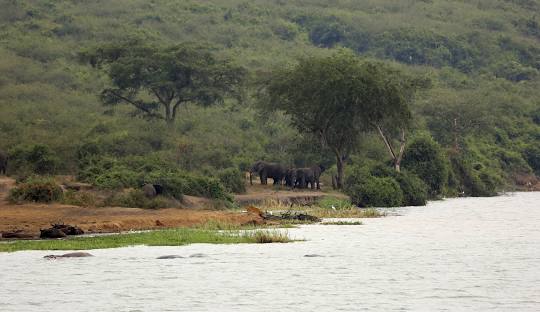
At the forefront are the hippos, boasting one of East Africa’s—and arguably the world’s—largest concentrations, with over 2,000 individuals. These semi-aquatic giants, weighing up to 1,500 kg each, form massive pods that grunt and splash in territorial displays, creating a symphony of sounds unique to the channel.
Nearby lurk Nile crocodiles, formidable predators sunning on the banks, their armored bodies blending into the muddy shores. Spotting a croc launch into the water is a heart-pounding highlight.
Mammals flock here too: elephants wade in for baths, their trunks spraying like fountains; buffaloes wallow in the shallows to escape ticks; and graceful antelopes like Uganda kob and waterbuck graze the fringes.
Warthogs and the occasional leopard add thrill, while the channel’s edges teem with smaller critters like monitor lizards—the largest in Africa.
But the avian spectacle steals the show, with over 600+ bird species recorded, making it an Important Bird Area (IBA). Keep your binoculars trained on the skies for the majestic African fish eagle, its white tail flashing as it dives for prey; colorful pied kingfishers hovering mid-air; flocks of great white pelicans gliding in formation; and the rare African skimmers skimming the surface for insects. Seasonal migrants like the shoebill stork (an endangered icon) might make a cameo, turning birders into ecstatic spotters.
This density of life—mammals, reptiles, and birds coexisting—makes the Kazinga Channel a microcosm of African wildlife, far surpassing many terrestrial game drives in sheer variety.
What is the Kazinga Channel Famous For? The Hippo Haven and Beyond
So, what is the Kazinga Channel famous for? Primarily, it’s renowned as a hippo paradise, hosting the densest population in the region and drawing wildlife filmmakers and photographers alike.
Documentaries like “The Kazinga Channel: Hippo Paradise” have cemented its status. Beyond hippos, it’s celebrated for the Kazinga Channel boat cruise, often hailed as Uganda’s best water-based safari, offering close encounters impossible on land.
The channel’s role in the Ramsar-listed wetland system adds eco-fame, while its bird diversity ranks it among Africa’s top ornithological sites. For many, it’s the “highlight of any Uganda safari,” blending raw nature with accessibility.
Kazinga Channel Boat Cruise: The Highlight of Your Safari
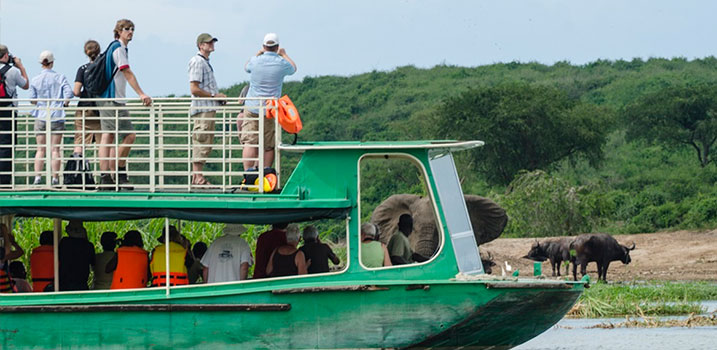
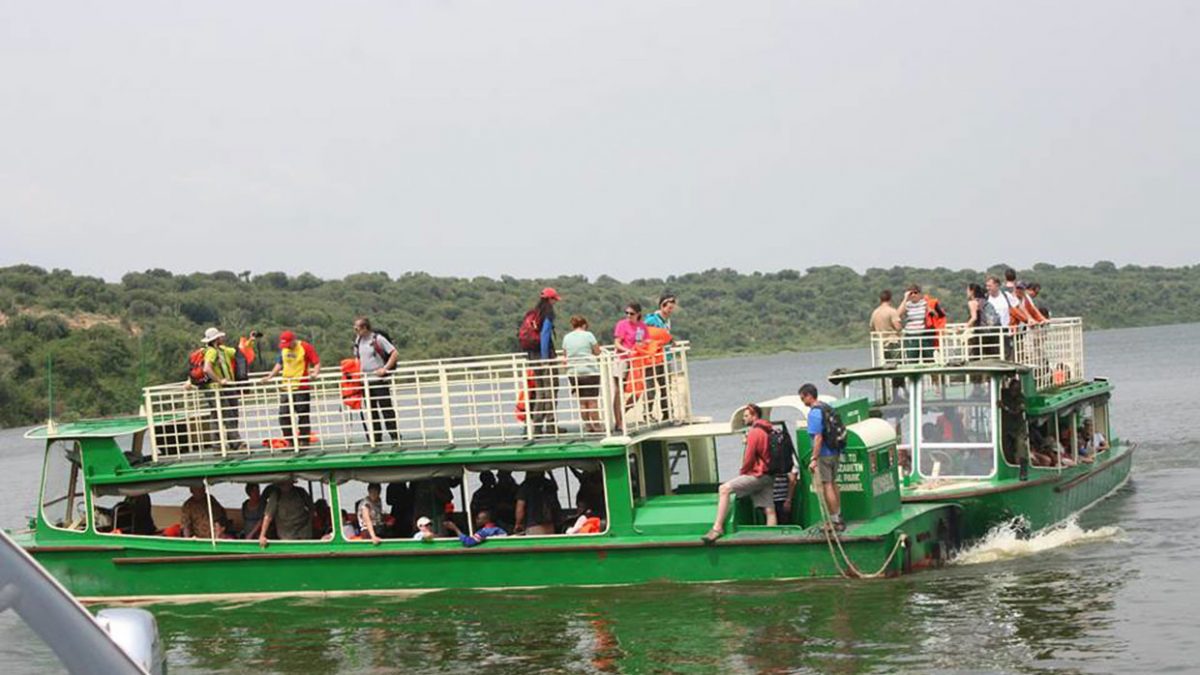
The Kazinga Channel boat cruise is the undisputed star— a 2-hour journey that transforms visitors into wide-eyed witnesses of nature’s theater. Operated primarily from the Mweya Peninsula, cruises depart twice daily: morning slots (around 9-11 am) for cooler temps and active birds, and afternoon ones (3-5 pm) for golden-hour mammal sightings and stunning sunsets.
Choose between UWA launch cruises (larger, budget-friendly boats) or private cruises from Mweya Safari Lodge, like the luxurious 12-seater Kingfisher with shaded decks and refreshments.
As your guide narrates, you’ll drift past hippo pods parting like submarines, elephants trumpeting from the banks, and birds in explosive displays. It’s intimate—no fences, just you and the wild—making it the best wildlife-viewing experience in Uganda. Pro tip: Opt for the afternoon for that magical light, perfect for photography.
Kazinga Channel Boat Cruise Fees: Updated Rates for 2025
Planning your budget? Kazinga Channel boat cruise price and cost remain affordable in 2025, emphasizing Uganda’s value-for-money safaris. The standard UWA boat cruise Queen Elizabeth National Park fee is $30 USD per person for foreign non-residents and residents alike—a flat rate covering the 2-hour trip. East African citizens pay UGX 30,000-70,000 (about $8-19 USD), depending on the operator.
Private hires or lodge boats (e.g., Mweya’s Sunbird) bump it to $50 USD for more comfort. Don’t forget Kazinga Channel entrance fees: $40 USD for foreign non-residents (24-hour validity), $30 USD for residents, and UGX 20,000 for East Africans—essential if combining with game drives.
How much does it cost to go to the Kazinga Channel? Factor in $70-100 total per person for cruise + entry, excluding transport. Prices can fluctuate, so check with UWA for updates; it’s a smart SEO note for dynamic travel planning.
Best Time to Visit the Kazinga Channel: Seasonal Magic
Timing is everything for “best time for Kazinga Channel cruise” and “best time to visit Kazinga Channel“. The dry season (June-September and December-February) reigns supreme, with low water levels concentrating wildlife at the shores for epic visibility. Fewer mosquitoes mean more comfort, and the savanna glows golden—ideal for “when to visit Queen Elizabeth National Park“.
Wet seasons (March-May, October-November) offer lush green backdrops and fewer crowds, great for landscape photography and bird migration peaks.
Avoid peak rains for boat safety, but embrace the drama of misty mornings. Overall, year-round appeal keeps it accessible, with 2025 forecasts predicting stable weather patterns.
How to Get to the Kazinga Channel: Routes and Directions
Reaching the channel is straightforward for “how to get to Kazinga Channel” seekers. From Kampala, it’s a scenic 6-hour drive (about 420 km) via the Kampala-Masaka-Mbarara highway, turning at Katunguru for the Kazinga Channel route and directions to Mweya (another 20 km). Paved roads make it 4×4-optional, but hire a safari vehicle for en-route game spotting.
Fly into Entebbe International Airport, then charter a flight to Kasese Airstrip (1 hour), followed by a 1-hour transfer. Access points include the Mweya jetty or Katunguru Bridge for eastern approaches. Public buses to Kasese cost under $20, but guided tours (from $150/day) handle logistics seamlessly.
Accommodation Near Kazinga Channel: Luxe to Budget Stays
After a day on the water, unwind at “lodges near Kazinga Channel” and “where to stay near Queen Elizabeth National Park“. Mweya Safari Lodge overlooks the channel, offering upscale tents with hippo-view balconies ($250+/night).
Elephant Plains Lodge provides mid-range thatched cottages amid plains ($150/night), while Parkview Safari Lodge delivers budget comfort with park vistas ($80/night).
For intimacy, Engiri Safari Lodge sits channel-side, blending rusticity with hot showers ($100/night). Book via Uganda Tourism Board for deals.
Activities Around Kazinga Channel: Beyond the Boat
The channel anchors a hub of “things to do near Kazinga Channel” and “Queen Elizabeth National Park activities“. Post-cruise, embark on game drives across Kasenyi Plains for lions and kobs. Lion tracking in Ishasha’s tree-climbing prides is a bucket-lister.
The explosion crater drive reveals volcanic calderas teeming with antelope, while birdwatching trails yield shoebills. Cultural tours with Bakiga communities add human stories.
For contrast, day-trip to Murchison Falls (4 hours north), where the Nile roars through a gorge—pairing channel calm with waterfall fury.
Major Tourist Attractions at Kazinga Channel: Icons of the Wild
The “major tourist attraction at Kazinga Channel” is unequivocally the boat cruise, but runners-up include hippo pods as natural spectacles and the Katunguru Bridge for panoramic views. The channel’s fishing villages offer cultural immersion, showcasing sustainable livelihoods amid wildlife.
Travel Tips for Visitors: Essential Kazinga Channel Safari Guide
For a flawless trip, heed these “Kazinga Channel travel tips” and “Kazinga Channel safari guide“. Pack binoculars, a zoom lens camera (e.g., Canon EOS for wildlife), sunscreen, hat, and anti-malarials—wet wipes tame hippo-mud splashes. Book cruises ahead via UWA or trusted tour operators.
Best cruise times: Afternoon for drama. Safety: Stay boat-bound; crocs lurk. Hydrate, wear neutrals, and tip guides ($5-10). Eco-tip: Use reef-safe products to protect the Ramsar wetland.
FAQs about Kazinga Channel
What is special about the Kazinga Channel? Its unmatched hippo density and boat-accessible wildlife make it uniquely immersive.
How long is the Kazinga Channel boat cruise? Precisely 2 hours, packed with sightings.
What animals can I see? Hippos, crocs, elephants, buffaloes, antelopes, and 600+ birds.
Is the Kazinga Channel safe? Yes, with experienced guides; follow rules to avoid wildlife risks.
Where is Kazinga Channel located? Southwestern Uganda, in Queen Elizabeth NP, linking Lakes George and Edward.
Book Your Adventure Today
Ready to dive into the wild heart of Uganda? Book your Kazinga Channel boat cruise with us today and enjoy a breathtaking wildlife experience in Queen Elizabeth National Park. Contact us for custom packages—your hippo symphony awaits. Don’t wait; spots fill fast in 2026!