Can I Fly Between Uganda’s National Parks? An Ultimate Guide 2026
Can I fly between Uganda’s national parks? Yes, you can fly between Uganda’s national parks. Aerolink Uganda operates daily scheduled flights from Entebbe International Airport to airstrips serving Murchison Falls National Park (Pakuba, Bugungu, and Chobe airstrips), Bwindi Impenetrable National Park (Kihihi and Kisoro airstrips), Queen Elizabeth National Park (Kasese and Mweya airstrips), Kidepo Valley National Park (Apoka airstrip), and Semuliki National Park (Semliki airstrip).
Flights take approximately 1 hour 15 minutes to 2 hours from Entebbe to each destination. Charter flights between parks — not via Entebbe — are available through Aerolink Uganda, Eagle Air, and BAR Aviation Uganda.
Flying to Uganda’s national parks eliminates drives of 6–10 hours and is the fastest, most comfortable way to maximise your time on safari.
If you are planning a Uganda safari and dreading the prospect of a 9-hour road transfer from Kampala to Bwindi or an 8-hour drive to Murchison Falls, flying is the answer.
Uganda’s domestic aviation network has grown significantly around tourism demand, and for visitors with limited time or a preference for comfort over road adventure, domestic flights between Uganda national parks are not just possible — they are a genuinely superior way to design an itinerary.
Which Uganda National Parks Can You Fly To?
Uganda has a network of airstrips serving its major national parks, all accessible via scheduled or charter flights operated primarily by Aerolink Uganda. Here is the complete airstrip map:
Murchison Falls National Park — Three Airstrips
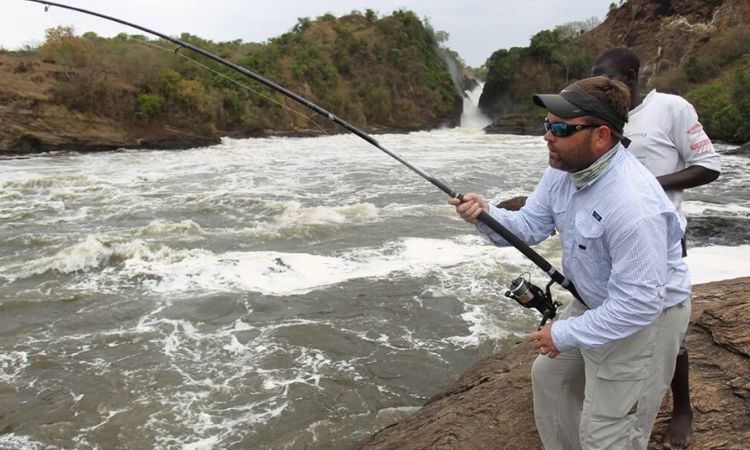
Murchison Falls National Park is served by three separate airstrips in different parts of the park, giving visitors the flexibility to land closest to their lodge:
Pakuba Airstrip — the most commonly used airstrip for Murchison Falls, located on the northern bank close to Paraa and the main game drive circuits. Most mid-range and budget lodges around Paraa use Pakuba as their transfer point.
Bugungu Airstrip — on Murchison Falls’ southern boundary, near the Bugungu entrance gate and the approach from Masindi. Useful for lodges positioned on the southern bank.
Chobe Airstrip — serves the western part of the park near Chobe Safari Lodge and the western game drive sectors. Ideal for guests staying at Chobe-area lodges.
The drive from Kampala or Entebbe to Murchison Falls takes 5–8 hours depending on traffic and road conditions. Flying cuts this to approximately 1 hour 15 minutes from Entebbe — giving back an entire day of your Uganda safari.
Bwindi Impenetrable National Park — Two Airstrips
Bwindi’s gorilla trekking sectors are some of the most remote destinations in Uganda’s road network. The park is served by two airstrips that align with its northern/southern geographic split:
Kihihi Airstrip — the primary access airstrip for Bwindi’s northern sectors: Buhoma (the oldest gorilla trekking sector) and Ruhija. From Kihihi, the transfer to Buhoma sector headquarters takes approximately 1.5 hours by road through some of Uganda’s most dramatic highland scenery.
Kihihi also provides access to Queen Elizabeth National Park’s northern areas and Kibale Forest National Park via connecting road transfers.
Kisoro Airstrip — serves Bwindi’s southern sectors: Rushaga (which hosts the most gorilla families and the only gorilla habituation experience in Uganda) and Nkuringo.
From Kisoro airstrip, it is approximately 1.5–2 hours to Rushaga by road. Kisoro also provides access to Mgahinga Gorilla National Park, which sits directly beside the airstrip in the Virunga foothills.
Without a flight, reaching Bwindi from Entebbe means a 9–10 hour road transfer via Kabale. Flying to Kihihi or Kisoro reduces this to approximately 1 hour 15 minutes in the air plus the ground transfer — saving the better part of a full day.
Queen Elizabeth National Park — Two Airstrips
Queen Elizabeth National Park is Uganda’s most ecologically diverse park and is served by:
Kasese Airstrip — located near Kasese town on the park’s eastern edge, approximately 30 minutes from the main Mweya Peninsula by road. Kasese is the more commonly used airstrip for most Queen Elizabeth lodges.
Mweya Airstrip — directly on the Mweya Peninsula, the park’s most popular lodge cluster area and the launch point for the Kazinga Channel boat cruise. Landing at Mweya is the most convenient option for guests staying at Mweya Safari Lodge, Jacana Lodge, or the Mweya tented camps.
The road from Kampala to Queen Elizabeth National Park takes approximately 6–7 hours. The flight from Entebbe is approximately 1 hour 15 minutes, with an immediate ground transfer to your lodge.
Kidepo Valley National Park — Apoka Airstrip
Apoka Airstrip in Kidepo Valley National Park is the gateway to one of Africa’s most isolated and extraordinary safari destinations. Kidepo sits in Uganda’s far northeastern corner near the South Sudan border — a 10–12 hour drive from Kampala on roads that mix tarmac, murram, and seasonal tracks.
For most visitors, flying to Kidepo via Apoka airstrip is not just preferable — it is the only practical option for a short Uganda safari that includes this park.
The flight service to Kidepo Valley National Park always operates on Fridays and Mondays with a minimum of four passengers. This scheduling means that Kidepo itineraries need to align with these flight days, which your tour operator will factor into the itinerary design. Charter flights to Apoka are available on other days if the scheduled service doesn’t align with your dates — at a higher per-seat cost.
Semuliki National Park — Semliki Airstrip
Aerolink Uganda also flies to Semuliki National Park via Semliki airstrip — serving Uganda’s most remote and least visited national park, located in the Albertine Rift Valley near the DRC border. Semuliki is a specialist destination for birding enthusiasts targeting Afrotropical lowland forest species and the unique hot springs at Sempaya.
Which Airlines Operate Domestic Flights Between Uganda’s National Parks?
Aerolink Uganda — The Primary Scheduled Operator
Aerolink Uganda is the most prominent player in Uganda’s domestic aviation sector. This airline specializes in scheduled flights to popular safari destinations, making it the go-to choice for tourists heading to major national parks.
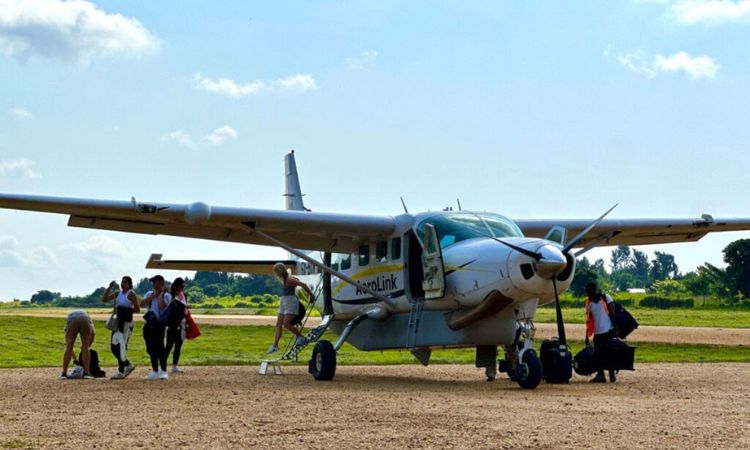
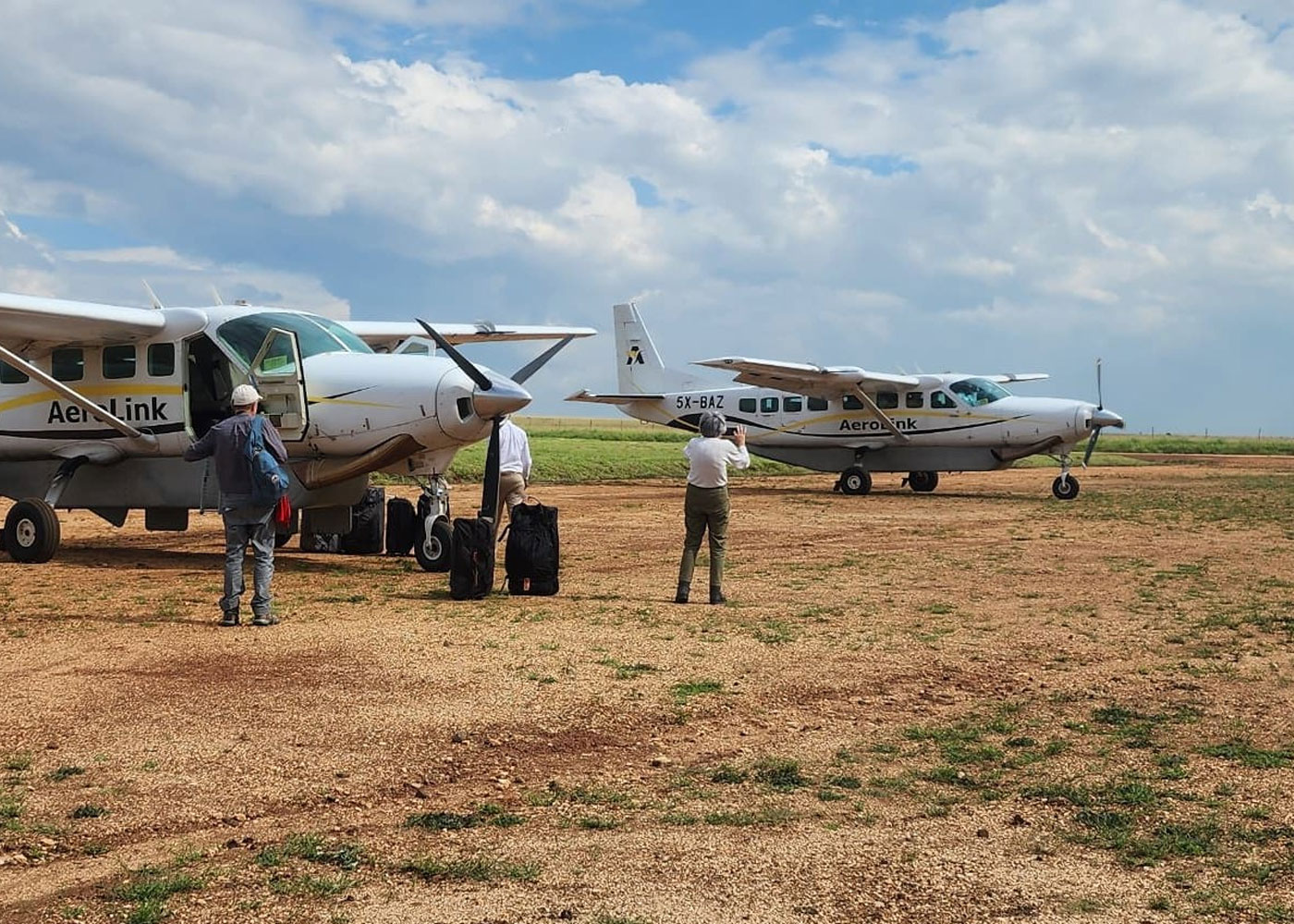
Aerolink Uganda mainly operates Cessna 208 Caravans with a fleet of up to 4 aircraft, each with the capability of accommodating 11 passengers at a time. Flights are flown by two expertly trained pilots operating full-glass cockpits.
The clear-glass cockpit design gives passengers an open, panoramic view over Uganda’s landscapes — turning the flight itself into a scenic experience rather than just transportation.
Aerolink Uganda is affiliated with Regional Air Services in Tanzania and AirKenya Express in Kenya, giving the airline network connectivity across East Africa. Aerolink is licensed by the Uganda Civil Aviation Authority and is the operator most Uganda safari operators book when arranging fly-in itineraries for their clients.
Baggage allowance on Aerolink: Aerolink Uganda provides baggage allowances for carry-on luggage not exceeding 15 kilograms of soft bags, including all hand baggage. Extra luggage is carried at extra charges.
The 15kg soft bag limit is important — hard-sided suitcases are difficult to fit in the small aircraft holds, and soft duffels or backpacks are strongly recommended for fly-in Uganda safari luggage.
Eagle Air Uganda
Eagle Air Uganda operates both scheduled flights and charter options, primarily serving northern Uganda but also covering the main safari parks.
For visitors needing flights on days or to destinations not covered by Aerolink’s scheduled service, Eagle Air provides an alternative — particularly for charter flights between parks.
BAR Aviation Uganda
BAR Aviation Uganda offers both scheduled and charter flight services to multiple airstrips across Uganda, providing additional options for visitors who need flexible departure times or routes not served by Aerolink’s scheduled network.
Charter Flights — Ultimate Flexibility
For visitors who want to fly directly between parks — Kihihi to Pakuba, for example, without routing back through Entebbe — charter flights are the answer. Any of the above airlines can arrange charter flights on request, at a higher per-person cost but with complete route flexibility and no fixed departure schedule constraints.
For groups of four or more, the cost of a charter flight between parks can be comparable to the per-seat rate on a scheduled flight once ground transfers and time savings are factored in.
Flying vs Driving Between Uganda National Parks — The Honest Comparison
The question of whether to fly or drive between Uganda’s national parks depends on three factors: your available time, your budget, and whether you value the road journey itself as part of the experience.
Time Saved by Flying
| Route | Road Transfer Time | Flight Time | Time Saved |
|---|---|---|---|
| Entebbe → Murchison Falls | 5–8 hours | ~1h 15min | 4–7 hours |
| Entebbe → Bwindi (Kihihi) | 9–10 hours | ~1h 15min + 1.5h transfer | ~6 hours |
| Entebbe → Bwindi (Kisoro) | 9–10 hours | ~1h 15min + 1.5h transfer | ~6 hours |
| Entebbe → Queen Elizabeth | 6–7 hours | ~1h 15min | 5–6 hours |
| Entebbe → Kidepo Valley | 10–12 hours | ~1h 30min | 9–10 hours |
| Murchison → Bwindi (road) | 8–10 hours | Charter ~45min + transfers | ~7 hours |
For a 10–14 day Uganda safari, the time savings from flying between parks can literally give you back 2–3 full days that would otherwise be spent in a vehicle.
The Case for Flying
Maximum wildlife time: Every hour saved on a transfer is an hour available for a game drive, gorilla trek, or boat cruise. On a tight itinerary, flying between Uganda’s national parks is the difference between a rushed safari and a relaxed one.
Avoiding fatigue: The road to Bwindi is genuinely demanding — steep, winding, and long. Arriving at your gorilla trekking lodge exhausted after 9 hours on the road is a poor way to prepare for one of Uganda’s most physically active wildlife experiences. Flying to Kihihi or Kisoro means you arrive fresh.
Scenic aerial views: Flying with Aerolink also gives visitors the chance to enjoy amazing views of Uganda, known as the “Pearl of Africa,” which they might not experience while traveling by road.
The flight from Entebbe to Pakuba passes over Lake Victoria, the Albertine Rift, and the Victoria Nile floodplain. The approach to Kihihi reveals the Bwindi forest canopy from the air — one of the most dramatic views in East Africa.
Kidepo is only practical by air: A 10–12 hour road transfer each way to Kidepo makes a short Kidepo visit essentially impossible. Flying makes a 2–3 night Kidepo extension into an itinerary that otherwise focuses on western Uganda entirely practical.
The Case for Driving
Cost: Domestic flights in Uganda cost approximately $150–$300 USD per person one way on scheduled services, depending on the destination. For budget safari travellers, the road transfer in a well-maintained 4×4 with an experienced driver is the more economical choice — and Uganda’s road network has improved significantly over the past decade.
The journey itself: The road from Kampala to Queen Elizabeth through Fort Portal passes through tea plantation highlands and some of Uganda’s most beautiful countryside.
The approach to Bwindi through Kabale’s terraced hills is extraordinary. For travellers who enjoy the land journey as part of the experience, driving offers what flying cannot.
Accessibility of Kibale from other parks: Kibale Forest National Park does not currently have its own commercial airstrip for regular scheduled services. Visitors flying to Kihihi can connect to Kibale by road (approximately 2–3 hours), but those prioritising Kibale chimpanzee trekking as a standalone destination typically drive from Entebbe or Fort Portal rather than flying. Kihihi also provides road access to Kibale, making a Bwindi-plus-Kibale fly-in itinerary workable.
How to Book Domestic Flights to Uganda National Parks
The simplest and most reliable approach is to book domestic flights through your Uganda safari operator, who will coordinate Aerolink’s schedule with your overall itinerary — ensuring ground transfers at each airstrip are arranged and that your gorilla or chimpanzee permits align with your arrival times.
Booking independently is possible on Aerolink Uganda’s website, though peak season availability on the most popular routes (Entebbe–Kihihi for gorilla trekking, Entebbe–Pakuba for Murchison) can be limited. Book as early as possible — at least 2–3 months ahead for June–September and December–February travel.
Key booking considerations:
Luggage: Pack soft duffel bags rather than hard suitcases for fly-in safaris. The 15kg soft bag limit on Aerolink is strictly enforced due to small aircraft weight limitations. Most Uganda fly-in safari lodges offer laundry services, so a lighter bag is perfectly manageable.
Flexibility: Schedules can be affected by weather conditions — particularly morning fog in the highland areas near Bwindi — and by minimum passenger requirements on some routes. Always have a contingency plan with your safari operator if a flight is delayed or rescheduled.
Kidepo scheduling: As noted above, Aerolink’s Kidepo Valley service operates specifically on Fridays and Mondays with a minimum of four passengers. Charter flights are available on other days but cost significantly more per seat. Design your Kidepo itinerary around these flight days.
Inter-park charter flights: If you want to fly directly between parks — for example, from Pakuba (Murchison) to Kasese (Queen Elizabeth) without returning to Entebbe — this requires a charter flight. Your safari operator can arrange this, and for groups of 4+ passengers, the cost becomes much more manageable per person.
Practical Tips for Flying to Uganda’s National Parks
Book early for peak season. Aerolink has limited seat capacity (11 passengers per aircraft) and peak season demand — June to September and December to February — fills quickly. For gorilla trekking fly-in safaris specifically, book your flights and permits together at least 4–6 months in advance.
Pack light. The 15kg soft-bag limit is non-negotiable on small bush aircraft. Most fly-in safari lodges in Uganda offer same-day laundry, making a 6–7kg kit perfectly workable for a week’s safari.
Confirm ground transfers at every airstrip. Your lodge or safari operator should have a vehicle waiting at the airstrip on arrival. The distance from airstrip to lodge varies from 10 minutes (Mweya airstrip to Mweya Peninsula) to 1.5 hours (Kihihi airstrip to Bwindi Buhoma). Confirm transfer arrangements before departure.
Allow transfer time in your schedule. A flight that takes 1 hour 15 minutes from Entebbe still requires you to be at Entebbe International Airport at least 1 hour before departure, plus the ground transfer at the other end. Build realistic total travel time into your day’s schedule.
Consider the direction of light for photography. The left side of the aircraft typically gives better views over Uganda’s western parks (Queen Elizabeth, Bwindi) on northbound flights. The right side offers better views of the Victoria Nile and Lake Albert corridor on the Murchison Falls route. Ask your operator or the ground crew at check-in.
Weather cancellations. Mist and low cloud in Bwindi’s highland areas occasionally cause flight delays or diversions, particularly in the rainy seasons (March–May and October–November). Travel insurance that covers domestic flight disruption is recommended.

FAQs: Flying Between Uganda’s National Parks
How much does it cost to fly to Murchison Falls National Park? Aerolink scheduled flights from Entebbe to Pakuba (Murchison Falls) cost approximately $150–$220 USD per person one way depending on the season and availability. Charter flights for groups cost significantly more per seat but offer route flexibility.
Can I fly directly from Bwindi to Murchison Falls? There is no scheduled inter-park flight on this route. A charter flight from Kihihi or Kisoro to Pakuba or Bugungu is available through Aerolink or Eagle Air — arrange through your safari operator. Alternatively, some itineraries route via Entebbe on the scheduled service.
Is flying to Kidepo Valley National Park worth it? Absolutely. Kidepo is 10–12 hours from Kampala by road — making a short visit extremely demanding without flying. The 1.5-hour flight to Apoka airstrip transforms Kidepo from a gruelling expedition into an accessible extension of any western Uganda safari circuit.
What happens if my domestic flight is cancelled? Your safari operator should have a contingency plan — typically a ground transfer as backup. Travel insurance that covers domestic flight disruption is strongly recommended for Uganda fly-in safaris, as small aircraft operations can be affected by weather, technical issues, or minimum passenger requirements.
Can I take a domestic flight to Kibale Forest National Park? Kibale does not currently have a regular commercial airstrip on Aerolink’s scheduled network. The most practical fly-in option for Kibale is to fly to Kihihi (for Bwindi) and connect to Kibale by road — approximately 2–3 hours.
Alternatively, fly to Kasese (Queen Elizabeth) and drive north to Kibale (approximately 2 hours). Charter flights to a small private airstrip near Fort Portal may be possible — check with your operator.
What luggage can I take on an Aerolink Uganda domestic flight? Maximum 15 kilograms in soft bags (duffel, backpack, or similar). Hard-sided suitcases cannot be accommodated. Camera equipment and electronics within the 15kg limit are fine. Additional weight can be carried at extra charge if space permits.